18V vs 12V Max Oscillating Tools in 2026: Key Differences
As an Amazon Associate we earn from qualifying purchases. Links on this page are affiliate links.
Choosing between an 18V vs 12V Max oscillating tool depends on your power needs and workspace. Both the Makita XMT03Z and the Milwaukee M12 are cordless multi-tools designed for cutting and sandging. They share a cordless power source and include only the tool body without batteries. The main difference lies in their voltage class and motor design. One offers higher potential power, while the other emphasizes efficiency and compactness. You need to weigh these specs against your typical projects.
Key differences
| Aspect | Makita XMT03Z 18V Oscillating Tool | Milwaukee M12 Brushless Oscillating Tool |
|---|---|---|
| Voltage | 18V | 12V Max |
| Motor Type | not listed | Brushless |
| Oscillation Angle | 3.2° | not listed |
| Speed Settings | Variable (6,000 to 20,000 OPM) | not listed |
| Weight | 1.4 kilograms | 1 pounds |
| Battery Included | not listed | Tool only |
Which one should you choose?
Choose Makita XMT03Z 18V Oscillating Tool if
- You need a larger oscillation angle for faster material removal
- You require a variable speed dial with a wide range
- You are already invested in the 18V LXT battery platform
Choose Milwaukee M12 Brushless Oscillating Tool if
- You prioritize a lighter tool for overhead or detailed work
- You want a brushless motor for potentially longer life and efficiency
- You prefer a more compact tool body for tight spaces
Verdict: The Makita XMT03Z suits users who need aggressive cutting power and adjustable speed control. The Milwaukee M12 is better for those who value a lighter, brushless design and compact handling. Your choice depends on whether you prioritize raw performance or ergonomic efficiency.
18V vs 12V Oscillating Tool Specs
Voltage and Power
The Makita XMT03Z operates on an 18V LXT platform, while the Milwaukee M12 uses a 12V Max system. Higher voltage generally correlates with greater potential torque and sustained power under load. The Makita’s 18V rating suggests it can handle more demanding cutting tasks or thicker materials without stalling as quickly. The Milwaukee’s 12V Max designation indicates a lighter duty profile, optimized for precision work and tighter spaces where maximum brute force is less critical than maneuverability. You should choose based on whether you prioritize raw cutting power or compact efficiency.
Motor Type
The Milwaukee M12 explicitly features a brushless motor, a detail confirmed in its attributes and key specs. Brushless motors typically offer longer life, increased efficiency, and better heat management compared to brushed alternatives. The Makita XMT03Z data does not specify the motor type, so you cannot confirm if it uses brushed or brushless technology. If motor longevity and efficiency are top priorities, the Milwaukee’s confirmed brushless design provides a clear technical advantage. For the Makita, you would need to consult external documentation to verify its internal motor construction.
Speed Control
The Makita XMT03Z includes a variable speed control dial ranging from 6,000 to 20,000 OPM. This allows you to precisely match the oscillation speed to the material, such as slowing down for delicate sanding or increasing for aggressive cutting. The Milwaukee M12 data does not list specific speed settings or a variable control dial. While many tools in this class have variable speeds, the absence of this data for the Milwaukee means you cannot confirm its adjustability. The Makita offers verified precision control for varied applications.
Oscillation Angle
The Makita XMT03Z features a 3.2-degree oscillation angle. This wider angle typically enables faster material removal and more aggressive cutting performance compared to narrower angles. The Milwaukee M12 data does not provide the oscillation angle specification. Without this number, you cannot directly compare the cutting aggressiveness or speed of material removal between the two tools. The Makita’s stated 3.2-degree angle suggests a design focused on efficiency and speed for standard cutting and sanding tasks.
Weight and Portability
The Milwaukee M12 weighs 1 pound, making it significantly lighter than the Makita XMT03Z, which weighs 1.4 kilograms (approximately 3.08 pounds). The Milwaukee’s lower weight reduces hand fatigue during overhead work or extended use in tight spaces. The Makita’s heavier build may provide more momentum for cutting but requires more effort to maneuver. If you frequently work in confined areas or overhead, the Milwaukee’s lighter profile offers a practical comfort advantage. For heavy-duty stationary work, the weight difference may be less impactful.
Run Time
The Makita XMT03Z data states that its 18V LXT battery provides up to 20 minutes of continuous run time. This gives you a baseline for expected performance on a single charge. The Milwaukee M12 data does not specify run time or battery capacity. Since both are sold as bare tools, actual performance will depend on the specific battery packs you use. However, the Makita’s published 20-minute figure provides a concrete expectation for continuous operation, whereas the Milwaukee’s runtime remains undefined in the provided specifications.
Accessory Change System
The Makita XMT03Z features a tool-less clamp system for fast accessory installation, enhancing workflow efficiency when switching blades or sanding pads. The Milwaukee M12 data does not explicitly describe its accessory change mechanism. While many Milwaukee M12 tools use a similar tool-less system, the provided data does not confirm this feature. If quick changes are a priority, the Makita’s confirmed tool-less clamp offers a verified convenience advantage. You should verify the Milwaukee’s specific mechanism through additional research if this feature is critical.
Which 18V or 12V tool fits you
Heavy duty cutters needing max power
The Makita XMT03Z delivers 18V power for aggressive work. Its 3.2-degree oscillation angle and variable speed dial (6,000 to 20,000 OPM) allow you to match speed to the task. The tool-less clamp system speeds up accessory changes. This model suits users who prioritize cutting speed and sustained torque for demanding jobs.
Precision workers valuing compact design
The Milwaukee M12 is a brushless tool weighing just 1 pound. Its 12V Max system offers a lighter, more maneuverable profile for detailed work. The compact size reduces fatigue during extended use. You get efficient power in a smaller form factor, ideal for tight spaces or tasks requiring precise control and less bulk.
Users wanting speed control flexibility
If you need to adjust RPMs for different materials, the Makita XMT03Z provides a variable speed control dial. This feature lets you fine-tune performance from 6,000 to 20,000 OPM. The larger oscillation angle also aids in faster material removal. This control is essential if you switch frequently between cutting and sanding applications.
Quick picks
| # | Product | Best for | Price |
|---|---|---|---|
| 1 | Makita XMT03Z 18V Oscillating Tool | high-speed cutting and sanding tasks | Check price of Makita XMT03Z 18V Oscillating Tool on Amazon |
| 2 | Milwaukee M12 Brushless Oscillating Tool | Lightweight precision work with existing M12 batteries | Check price of Milwaukee M12 Brushless Oscillating Tool on Amazon |
The products compared

Makita XMT03Z 18V Oscillating Tool
Best for: high-speed cutting and sanding tasks
- Voltage
- 18V (what this guide is about)
- Power Source
- Cordless, 18V LXT
- Speed Settings
- Variable speed control dial
- Oscillation Angle
- 3.2°
- Blade Change
- Tool-less clamp system
- Included Tools
- Oscillating Tool
View on Amazon: Makita XMT03Z 18V Oscillating Tool Affiliate link
This 18V cordless multi-tool offers variable speed control from 6,000 to 20,000 OPM. Its 3.2-degree oscillation angle supports faster cutting and sanding. The tool-less clamp system allows for quick accessory changes. You get a large slide switch with a lock-on button for convenience. It is designed for users who need higher power and speed for demanding tasks.
Pros
- Variable speed dial ranges from 6,000 to 20,000 OPM
- 3.2-degree oscillation angle for aggressive cutting
- Tool-less clamp system for fast accessory installation
- Large on/off slide switch with lock-on button
Cons
- Heavier at 1.4 kilograms compared to lighter 12V options
- Shorter continuous run time of up to 20 minutes
- Standard size may be bulky for tight spaces
Good fit if
- You need higher speed settings for tough materials
- You prefer a larger switch for easier operation
- You work with 18V LXT battery systems
Skip if
- You require extended run time beyond 20 minutes
- You need a lightweight tool for overhead work
- You prefer a more compact design for tight spaces
Verdict: Makita 18V LXT Oscillating Multi-Tool fits professionals who prioritize speed and power over lightweight portability. It is ideal for users already invested in the 18V LXT ecosystem who need aggressive cutting capabilities.
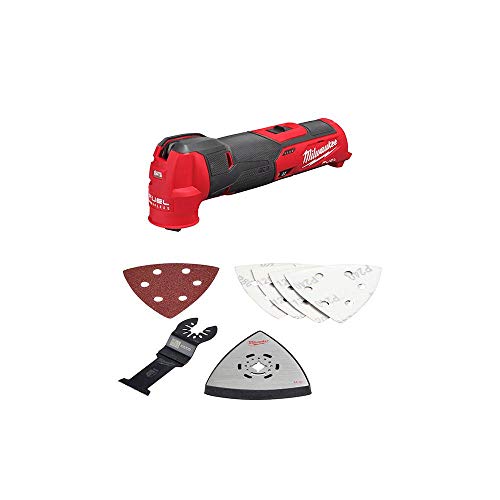
Milwaukee M12 Brushless Oscillating Tool
Best for: Lightweight precision work with existing M12 batteries
- Voltage
- 12V Max (what this guide is about)
- Power Source
- Cordless, M12
- Motor Type
- Brushless
- Battery Included
- Tool only
- Included Tools
- Oscillating Tool
- Dimensions
- 12 × 5 × 3 inches
View on Amazon: Milwaukee M12 Brushless Oscillating Tool Affiliate link
This is a 12V Max cordless oscillating multi-tool from Milwaukee. It features a brushless motor for efficient power delivery. The tool-only model weighs just 1 pound and measures 12 inches in length. Its compact 5-inch width and 3-inch height make it easy to maneuver in tight spaces. You get the tool without a battery. This kit suits users who already own M12 batteries and need a lightweight option for detailed work.
Pros
- Brushless motor for extended runtime
- Lightweight 1-pound design
- Compact 12-inch length
- Compatible with M12 battery system
Cons
- Tool-only configuration requires separate battery purchase
- Lower 12V voltage limits cutting depth compared to 18V models
- No included carrying case or accessories
Good fit if
- You already own Milwaukee M12 batteries
- You need a lightweight tool for overhead work
- You perform detailed trimming in tight spaces
Skip if
- You require high-power cutting for thick materials
- You do not own compatible M12 batteries
- You need an 18V system for maximum torque
Verdict: Milwaukee 12V Brushless Oscillating Tool is a lightweight, efficient option for users who already have M12 batteries and need precision in tight spaces. It is not suitable for heavy-duty cutting tasks that require higher voltage.
Specifications side by side
| Spec | Makita XMT03Z 18V Oscillating Tool | Milwaukee M12 Brushless Oscillating Tool |
|---|---|---|
| Power Source | Cordless, 18V LXT | Cordless, M12 |
| Voltage | 18V | 12V |
| Motor Type | not stated | Brushless |
| Speed Settings | Variable speed control dial | not stated |
| Oscillation Angle | 3.2° | not stated |
| Blade Change | Tool-less clamp system | not stated |
| Battery Included | not stated | Tool only |
| Included Tools | Oscillating Tool | Oscillating Tool |
| Dimensions | 3.9 × 12.2 × 4.9 inches | 12 × 5 × 3 inches |
| Weight | 1.4 kilograms | 1 pounds |
| Size | standart | not stated |
| Color | Deep Blue | Red |
| Model | XMT03Z-cr | 2526-20 |
Frequently asked questions
Is 18V better than 12V Max for cutting hard materials?
Yes, 18V tools generally offer more torque for aggressive cutting. The Makita XMT03Z uses an 18V platform to handle high-speed tasks effectively. Its 1.4-kilogram weight supports sustained power under load. The 12V Milwaukee model is lighter but less suited for heavy-duty cutting.
Which oscillating tool is lighter for overhead work?
The Milwaukee M12 Brushless model is the lighter option at one pound. It measures 12 inches in length and 5 inches in width. This compact design helps you work in tight spaces without fatigue. The Makita XMT03Z weighs 1.4 kilograms, making it heavier for extended overhead use.
Do these tools come with batteries included?
The Milwaukee M12 is sold as a bare tool, meaning it does not include a battery. The Makita XMT03Z is also listed as a tool-only unit. You will need to purchase compatible batteries separately for either brand if you do not already own them.
Can I use an 18V tool for precision sanding?
Yes, the Makita XMT03Z is designed for high-speed sanding tasks. It fits professionals who prioritize speed and power. Its standard size and 12.2-inch width provide stability. You can achieve precise results if you control the tool carefully despite its higher power output.
What is the size difference between 18V and 12V models?
The 18V Makita is larger, measuring 12.2 inches wide and 4.9 inches high. The 12V Milwaukee is more compact at 5 inches wide and 3 inches high. The Milwaukee’s smaller footprint makes it easier to maneuver in confined areas compared to the bulkier 18V unit.
Is a brushless motor better for an oscillating tool?
Brushless motors offer greater efficiency and longer runtime. The Milwaukee M12 features a brushless motor, which reduces maintenance needs. This technology helps maintain power as the battery drains. The Makita XMT03Z data does not specify its motor type, so its efficiency profile remains unclear from the specs.
Which tool is better for users with existing battery packs?
Choose based on your existing battery ecosystem. The Milwaukee M12 fits users who already own M12 batteries. The Makita XMT03Z is ideal for those invested in the 18V LXT system. Both tools are cordless and require compatible batteries to operate effectively in your workspace.