Milwaukee vs Bosch: Drill Drivers Compared by Specs
As an Amazon Associate we earn from qualifying purchases. Links on this page are affiliate links.
When you compare milwaukee vs bosch drill driver options, you are looking at two distinct approaches to cordless power tools. Both brands offer brushless motor technology and cordless operation for portability. The main difference lies in their design philosophy and power output. The Milwaukee unit focuses on high-torque impact driving, while the Bosch model emphasizes versatility through a modular attachment system. Understanding these spec differences helps you pick the right tool for your specific tasks.
Key differences
| Aspect | Milwaukee 18V 1/4-Inch Hex Impact Driver | Bosch 12V Max Flexiclick Drill |
|---|---|---|
| Voltage | 18V | 12V Max |
| Tool Type | Impact Driver | Drill/Driver |
| Maximum Torque | 2,000 in-lbs | 300 in-lbs |
| Chuck Size | 1/4 in. hex | Keyless |
| Tool Weight | 2.2 lbs | 1.2 lbs |
| Speed Settings | 4 mode drive control | 2-speed |
Which one should you choose?
Choose Milwaukee 18V 1/4-Inch Hex Impact Driver if
- You need high torque for driving long screws or lag bolts
- You prefer a dedicated impact driver for fastening tasks
- You work with standard 1/4-inch hex bits
Choose Bosch 12V Max Flexiclick Drill if
- You need a lightweight tool for overhead or tight spaces
- You want versatility with interchangeable attachments like a right-angle head
- You prefer a keyless chuck for quick bit changes
Verdict: The Milwaukee is the better choice for heavy-duty fastening where maximum torque is critical. The Bosch suits users who need a compact, versatile drill/driver with modular capabilities for detailed work. Choose based on whether you prioritize raw power or adaptable functionality.
Milwaukee vs Bosch Spec Comparison
Voltage and Power
The Milwaukee 2953-20 operates at 18V, while the Bosch GSR12V-300FCB22 runs on 12V Max. Higher voltage typically translates to greater torque potential. The Milwaukee delivers up to 2,000 in-lbs of torque, significantly outpacing the Bosch’s 300 in-lbs. This makes the Milwaukee better suited for heavy-duty fastening and demanding applications. The Bosch is designed for lighter tasks where precision matters more than raw force. You should choose the Milwaukee if you need maximum driving power. The Bosch is sufficient for light assembly or delicate work.
Motor Type
Both tools feature brushless motors, which offer longer runtime and increased durability compared to brushed alternatives. The Bosch explicitly highlights its brushless motor for efficiency. The Milwaukee also utilizes brushless technology, though the feature list emphasizes performance metrics like RPM and torque over the motor type itself. Since both brands employ this efficient technology, neither holds a distinct advantage in this specific category. You get extended tool life and reduced maintenance needs with either choice. The difference lies in how that power is utilized rather than the motor architecture itself.
Chuck and Bit System
The Milwaukee uses a 1/4-inch hex chuck, standard for impact drivers. It supports single-handed bit insertion, which speeds up workflow when changing bits frequently. The Bosch offers a 5-in-1 Flexiclick system with a keyless chuck attachment for drilling and a magnetic bit holder for driving. This system allows for quick changes between drilling, driving, and right-angle operations without removing the tool from the workspace. The Bosch provides more versatility in attachment types, while the Milwaukee is optimized strictly for hex-bit driving tasks.
Speed Settings
The Bosch features a two-speed transmission, offering a low range of 0-460 RPM for high torque and a high range of 1,750 RPM for speed. The Milwaukee lists 3,900 RPM as its maximum speed but describes its control as a 4-mode drive control rather than distinct gear speeds. The Milwaukee’s higher top speed is beneficial for rapid fastening. The Bosch’s dual gears allow for better control in different material densities. You may prefer the Bosch for varied drilling needs or the Milwaukee for consistent high-speed driving.
Weight and Portability
Weight is a critical factor for overhead work or prolonged use. The Bosch GSR12V-300FCB22 weighs only 1.2 lbs without the battery, making it the lighter option. The Milwaukee 2953-20 weighs 2.2 lbs tool-only. The Bosch’s compact design and lighter weight reduce user fatigue during extended periods. The Milwaukee is heavier, which can provide a sense of solidity but adds strain over time. If you are working in tight spaces or overhead, the Bosch’s lighter profile is a practical advantage for comfort and control.
Which tool fits your specific job needs best
Heavy duty construction workers needing high torque
The Milwaukee 2953-20 delivers 2,000 in-lbs of torque and 3,900 RPM. This high power output handles demanding fastening tasks efficiently. Its 18V system provides the strength required for structural work. The 4-mode drive control offers precise settings for various materials. You get significant power in a tool weighing 2.2 lbs.
Precision mechanics working in tight spaces
The Bosch GSR12V-300FCB22 weighs only 1.2 lbs, making it easy to maneuver in confined areas. Its compact design reduces fatigue during extended use. The Flexiclick system allows for quick attachment changes. The 12V Max brushless motor provides efficient runtime. You benefit from a lightweight tool that fits into narrow gaps without bulk.
DIYers needing versatile attachments for home projects
The Bosch kit includes a right-angle attachment that rotates to 16 positions. This versatility helps you work in awkward spots around furniture or cabinetry. The keyless chuck simplifies bit changes for different drilling tasks. You gain access to multiple configurations without buying separate tools. The compact size ensures it is easy to store in a home toolbox.
The products compared

Milwaukee 18V 1/4-Inch Hex Impact Driver
Best for: Heavy-duty fastening with existing M18 batteries
- Power Source
- Cordless
- Voltage
- 18V
- Maximum Torque
- 2,000"/lbs
- Chuck Size
- 1/4" Hex
- Battery Included
- Tool Only
- Included Tools
- Impact Driver
View on Amazon: Milwaukee 18V 1/4-Inch Hex Impact Driver Affiliate link
This Milwaukee 2953-20 is an 18V cordless impact driver sold as a tool only. It delivers up to 2,000 in-lbs of torque and reaches 3,900 RPM. The compact 4.47-inch body weighs 2.2 lbs. You get a 4-mode drive control and tri-LED lights. It suits users who already own M18 batteries and need high torque for fastening tasks.
Pros
- Delivers 2,000 in-lbs of torque
- Reaches 3,900 RPM
- Compact 4.47-inch length
- Includes tri-LED lights
Cons
- Sold as a tool only without batteries
- No drill chuck for standard bits
- Heavier than some 12V competitors
Good fit if
- You already use Milwaukee M18 batteries
- You need high torque for heavy fastening
- You prefer a compact tool body
Skip if
- You need a drill/driver combo
- You want a complete kit with batteries
- You prefer lighter 12V tools
Verdict: Milwaukee 2953-20 18V Impact Driver offers serious torque in a small package. It fits pros who already have M18 batteries and need power for demanding jobs.
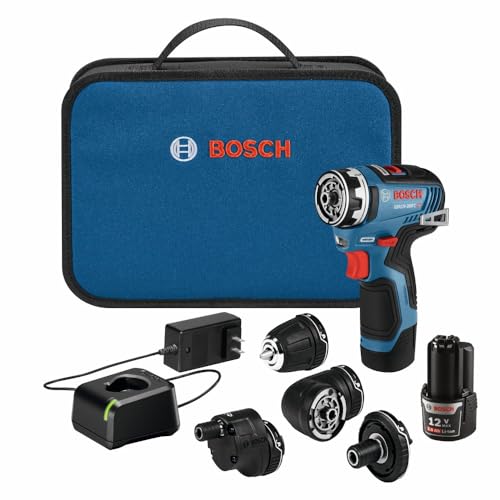
Bosch 12V Max Flexiclick Drill
Best for: precision tasks in confined areas
- Power Source
- 12V Max
- Voltage
- 12V
- Maximum Torque
- 300 in.-lbs.
- Motor Type
- Brushless
- Included Tools
- Drill/Driver
- Speed Settings
- 2-speed
View on Amazon: Bosch 12V Max Flexiclick Drill Affiliate link
This Bosch drill driver uses a 12V Max brushless motor to deliver 300 in.-lbs. of torque and speeds up to 1,750 rpm. It features a two-speed transmission and a compact 1.2 lb design. The Flexiclick system includes a right-angle attachment for tight spaces and a magnetic bit holder. It suits users needing versatility in a small form factor.
Pros
- Brushless motor for longer runtime
- Two-speed transmission (0-460 and 1,750 rpm)
- Compact 1.2 lb tool weight
- Right-angle attachment for tight spaces
- Magnetic bit holder for short head length
Cons
- Lower 300 in.-lbs. torque compared to 18V competitors
- 12V Max voltage limits heavy-duty performance
- Tool-only weight excludes battery mass
Good fit if
- You need a compact tool for tight spaces
- You prefer a lighter 12V system for precision work
- You require versatile attachments like a right-angle head
Skip if
- You need high torque for large fasteners
- You require an 18V Max power source
- You want a high-speed impact driver instead
Verdict: Bosch 12V Max Flexiclick Drill Driver fits users who prioritize compact size and attachment versatility over raw power. It is ideal for precision tasks in confined areas rather than heavy construction.
Specifications side by side
| Spec | Milwaukee 18V 1/4-Inch Hex Impact Driver | Bosch 12V Max Flexiclick Drill |
|---|---|---|
| Power Source | Cordless | 12V Max |
| Voltage | 18V | 12V |
| Maximum Torque | 2,000"/lbs | 300 in.-lbs. |
| Chuck Size | 1/4" Hex | not stated |
| Motor Type | not stated | Brushless |
| Battery Included | Tool Only | not stated |
| Included Tools | Impact Driver | Drill/Driver |
| Speed Settings | 4 mode | 2-speed |
| Tool Weight | 2.2lbs | 1.2 lbs. (tool only) |
| Wheel Diameter | not stated | 5 Inch |
| Dimensions | 241 × 99 × 137 inches | 2 × 1.6 × 7.1 inches |
| Weight | 2.49 pounds | not stated |
| Color | Red | Black |
| Model | 2953-20-NBX | GSR12V-300FCB22 |
| Size | not stated | 45 in |
Frequently asked questions
Which drill driver is better for heavy-duty construction work?
The Milwaukee 2953-20 is the superior choice for demanding construction tasks. It operates at 18V and delivers high torque suitable for structural fastening. Its robust design handles tough materials better than the Bosch option. You should select this tool if your primary need is raw power and durability on site.
Is the Bosch drill driver suitable for tight spaces?
Yes, the Bosch GSR12V-300FCB22 is designed for precision work in confined areas. Its compact dimensions allow for easy maneuverability where larger tools cannot fit. This makes it ideal for detailed assembly or intricate tasks rather than heavy-duty applications. You will find it easier to handle in small gaps.
How does the voltage difference affect performance?
The Milwaukee 18V system provides significantly more power than the Bosch 12V Max unit. Higher voltage generally translates to greater torque potential for driving large fasteners. The Milwaukee delivers up to 2,000 in-lbs of torque, while the Bosch offers 300 in-lbs. Choose the Milwaukee for strength and the Bosch for control.
Do I need to buy batteries for these tools?
You must purchase batteries separately for the Milwaukee 2953-20, as it is sold as a bare tool. This option is best if you already own compatible M18 batteries. The Bosch kit includes batteries, so you can start using it immediately. Check your existing tool ecosystem before deciding which platform fits your needs.
Which tool is lighter and more portable?
The Bosch GSR12V-300FCB22 is notably lighter and more compact. It weighs less than half the Milwaukee unit, making it easier to carry and use overhead. The Milwaukee 2953-20 weighs 2.49 pounds, which may cause fatigue during extended use. Select the Bosch if you prioritize weight reduction and handheld comfort.
What is the difference between an impact driver and a drill driver?
The Milwaukee tool is an impact driver, designed for high-torque fastening. It uses rotational impacts to drive screws efficiently without stripping heads. The Bosch is a drill driver, better suited for drilling holes and precise fastening. Use the Milwaukee for heavy-duty bolting and the Bosch for versatile drilling and light assembly tasks.