Milwaukee vs RYOBI Reciprocating Saws: Which Brand Fits You?
As an Amazon Associate we earn from qualifying purchases. Links on this page are affiliate links.
This milwaukee vs RYOBI reciprocating saw comparison focuses on two compact, one-handed tools. Both units share a 14.8-inch length and brushless motors for efficient power delivery. The Milwaukee model features a 7/8-inch stroke length and a pivoting shoe for stability. The RYOBI option offers a tool-free blade change and a higher stroke rate. You get bare tools from both brands, requiring separate battery purchases.
Key differences
| Aspect | Milwaukee M18 FUEL One-Handed Hackzall | RYOBI ONE+ Brushless One-Handed Reciprocating Saw |
|---|---|---|
| Stroke Length | 7/8 in. | not listed |
| Strokes Per Minute | not listed | Up to 3,000 SPM |
| Blade Change | not listed | Tool-free |
| Weight | 3.97 pounds | 3.75 pounds |
| Special Feature | Pivoting shoe | None listed |
Which one should you choose?
Choose Milwaukee M18 FUEL One-Handed Hackzall if
- You need a longer stroke length for faster material removal
- You want a pivoting shoe for smoother cuts with less vibration
- You prefer the Milwaukee M18 battery ecosystem
Choose RYOBI ONE+ Brushless One-Handed Reciprocating Saw if
- You prioritize a lighter tool for overhead work
- You need quick, tool-free blade swaps
- You want a higher maximum stroke rate for efficiency
Verdict: Choose the Milwaukee if you need the aggressive 7/8-inch stroke and pivoting shoe for heavy-duty control. Pick the RYOBI if you value the lighter weight, tool-free blade changes, and high stroke rate for fast, precise cuts in tight spaces.
Milwaukee vs RYOBI Recip Saw
Weight and Portability
You often need to hold these tools overhead or in tight spots. The Milwaukee M18 FUEL One-Handed Hackzall weighs 3.97 pounds. The RYOBI ONE+ HP Brushless One-Handed Reciprocating Saw is lighter at 3.75 pounds. That 0.22-pound difference matters when you work for hours. The RYOBI model reduces hand fatigue slightly more. Both tools share the same 14.8-inch length, so reach is identical. You choose the lighter option for extended one-handed use.
Stroke Length and Power
Cutting speed depends on how much material each stroke removes. The Milwaukee tool specifies a 7/8-inch stroke length. This longer stroke removes more material per cycle, which can speed up cuts in tough applications. The RYOBI saw does not list a specific stroke length in its provided data. It highlights a high stroke rate of up to 3,000 strokes per minute. Without the Milwaukee's stated longer stroke, you may need more cycles to remove the same amount of material. The Milwaukee has the advantage here for aggressive cutting.
Motor Technology
Both tools use brushless motors for efficiency and durability. The Milwaukee model features the POWERSTATE Brushless Motor combined with REDLINK Plus Intelligence. This system monitors tool, battery, and charger communication to prevent overload and optimize performance. The RYOBI saw uses a brushless motor but does not list an equivalent intelligence system in the data. Both offer reliable power delivery. However, the Milwaukee's integrated electronics provide specific claims about tool life and overload protection that are not detailed for the RYOBI unit.
Blade Change System
Quick blade swaps keep you productive on job sites. The RYOBI saw includes a Rapid blade change system for quick, tool-free swaps. This allows you to change blades between wood, metal, and plastic tasks without extra tools. The Milwaukee data does not specify its blade change mechanism. It highlights a pivoting shoe for stability but omits the blade locking method. If you frequently switch blades, the RYOBI's explicit tool-free feature is a clear practical advantage for workflow speed.
Battery Ecosystem
Both tools are sold as bare tools, meaning you need a compatible battery. The Milwaukee unit uses the M18 platform. The RYOBI saw is part of the ONE+ 18V system. The RYOBI data notes compatibility with over 300 ONE+ batteries. This vast ecosystem allows you to use existing RYOBI batteries across many tools. The Milwaukee M18 system is also extensive, but the specific count of compatible tools is not provided in the data. For users already invested in RYOBI, the breadth of available batteries offers significant convenience.
Which One Should You Buy?
Users needing faster cuts in tight spaces
The RYOBI PSBRS01B delivers up to 3,000 strokes per minute. This high speed helps you cut through wood, metal, or plastic efficiently. Its tool-free blade clamp allows quick swaps without extra tools. The compact design fits overhead or tight spots easily. You save time on demolition projects with this rapid performance and easy maintenance.
Professionals prioritizing durability and stability
The Milwaukee 2719-20 features a pivoting shoe for constant contact with the workpiece. This design reduces bucking and vibration for smoother cuts. Its POWERSTATE brushless motor and REDLINK Plus Intelligence provide overload protection. These electronics optimize performance and extend tool life up to three times longer than competitive one-handed reciprocating saws.
Those wanting the lightest possible option
Weighing only 3.75 pounds, the RYOBI saw is the lighter choice. This reduces fatigue when holding the tool overhead or in awkward positions. The compact one-handed design enhances control in tight spaces. You benefit from a tool that is easier to maneuver for extended periods without compromising the power of its brushless motor.
The products compared
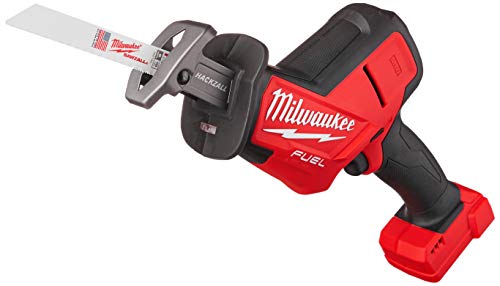
Milwaukee M18 FUEL One-Handed Hackzall
Best for: tight spaces and users with M18 batteries
- Power Source
- M18
- Stroke Length
- 7/8 in.
- Motor Type
- Brushless
- Battery Included
- Bare Tool
- Tool Weight
- 3.97 pounds
- Tool Length
- 14.8 inches
View on Amazon: Milwaukee M18 FUEL One-Handed Hackzall Affiliate link
The Milwaukee M18 FUEL Hackzall is a one-handed reciprocating saw designed for superior control. It features a brushless motor and a 7/8-inch stroke length for faster cuts. The tool weighs 3.97 pounds and measures 14.8 inches long. It uses the M18 battery system. This bare tool requires a separate battery and charger. It suits users who need compact power for tight spaces.
Pros
- POWERSTATE Brushless Motor for increased cutting speed
- 7/8 inch stroke length removes more material per stroke
- Pivoting shoe provides constant contact for smoother cuts
- REDLINK Plus Intelligence offers overload protection
Cons
- Sold as a bare tool without battery or charger
- Heavier than standard one-handed reciprocating saws at 3.97 pounds
- Requires M18 battery system which is not included
Good fit if
- You need a one-handed saw for tight spaces
- You already own M18 batteries and chargers
- You want a pivoting shoe for smoother cuts
Skip if
- You need a complete kit with battery and charger
- You prefer a lighter tool under 3 pounds
- You only use standard two-handed reciprocating saws
Verdict: Milwaukee M18 FUEL Hackzall One-Handed Saw offers high power in a compact form. It fits professionals who already have M18 batteries and need precise control in tight spaces.

RYOBI ONE+ Brushless One-Handed Reciprocating Saw
Best for: tight spaces and overhead cuts
- Power Source
- 18V
- Strokes Per Minute
- Up to 3,000 SPM
- Motor Type
- Brushless
- Battery Included
- Tool only
- Tool Weight
- 3.75 pounds
- Tool Length
- 14.8 inches
View on Amazon: RYOBI ONE+ Brushless One-Handed Reciprocating Saw Affiliate link
This RYOBI ONE+ HP reciprocating saw uses a brushless motor to deliver up to 3,000 strokes per minute. It features a compact one-handed design that weighs 3.75 pounds and measures 14.8 inches long. The tool-free blade clamp allows for quick swaps. It is part of the RYOBI ONE+ 18V system, making it suitable for users who already own compatible batteries. It suits tight spaces and overhead work.
Pros
- Brushless motor provides up to 3,000 SPM
- Compact one-handed design fits tight spaces
- Tool-free blade change system for quick swaps
- Lightweight at 3.75 pounds
Cons
- Sold as a bare tool without battery or charger
- Single speed limit of 3,000 SPM
- No variable speed trigger mentioned in specs
Good fit if
- You need a lightweight saw for overhead cuts
- You already use RYOBI ONE+ 18V batteries
- You work in tight spaces requiring one-handed use
Skip if
- You require a variable speed trigger for delicate cuts
- You need a complete kit with battery and charger
- You prefer a heavier, two-handed saw for stability
Verdict: RYOBI 18V Brushless Compact Recip Saw is a solid choice for users who already own RYOBI 18V batteries and need a lightweight tool for tight spaces. It offers efficient cutting speeds but lacks variable speed control.
Specifications side by side
| Spec | Milwaukee M18 FUEL One-Handed Hackzall | RYOBI ONE+ Brushless One-Handed Reciprocating Saw |
|---|---|---|
| Power Source | M18 | 18V |
| Stroke Length | 7/8 in. | not stated |
| Strokes Per Minute | not stated | Up to 3,000 SPM |
| Motor Type | Brushless | Brushless |
| Battery Included | Bare Tool | Tool only |
| Tool Weight | 3.97 pounds | 3.75 pounds |
| Tool Length | 14.8 inches | 14.8 inches |
| Blade Clamp | not stated | Tool-free |
| Voltage | not stated | 18V |
| Included Tools | not stated | Reciprocating Saw |
| Dimensions | 14.8 × 4.4 × 6.8 inches | 14.8 × 7.28 × 3.5 inches |
| Weight | 3.97 pounds | 3.75 pounds |
| Size | Large | Compact |
| Color | Red, Black | Ryobi Green |
| Model | 2719-20 | #PSBRS01B |
Frequently asked questions
Is the Milwaukee Hackzall compatible with existing M18 batteries?
Yes, it works with your current M18 power source. The listing identifies this unit as a bare tool, meaning it does not include a battery or charger. You must supply your own M18 battery to operate the saw. This design allows you to save money if you already own the Milwaukee battery ecosystem.
Which reciprocating saw is better for overhead work?
The RYOBI ONE+ Brushless One-Handed Reciprocating Saw is a strong candidate for overhead tasks. It weighs 3.75 pounds, making it slightly lighter than the Milwaukee option. Its compact size and lower weight reduce fatigue when holding the tool above your head for extended periods.
Does the Milwaukee saw come with a battery included?
No, the Milwaukee M18 FUEL One-Handed Hackzall is sold as a bare tool. You will need to purchase an M18 battery and charger separately. This approach benefits users who already have Milwaukee batteries, allowing them to use the tool immediately without buying redundant power sources.
How wide is the Milwaukee M18 Hackzall body?
The Milwaukee model has a width of 4.4 inches. This narrow profile helps you fit the tool into tight spaces where larger saws cannot reach. The compact dimensions make it suitable for detailed work in confined areas, such as between studs or in crowded utility boxes.
What is the weight difference between these two saws?
The RYOBI saw weighs 3.75 pounds, while the Milwaukee saw weighs 3.97 pounds. This creates a difference of 0.22 pounds. While the difference is small, the lighter RYOBI unit may feel less burdensome during long jobs or when working at awkward angles.
Can I use the RYOBI saw with 18V batteries?
Yes, the RYOBI ONE+ model is designed for the 18V system. The product data specifies an 18V voltage rating. Like the Milwaukee option, it is listed as a bare tool, so you must provide your own 18V battery to power the brushless motor.
What color is the RYOBI reciprocating saw?
The RYOBI ONE+ Brushless One-Handed Reciprocating Saw is finished in Ryobi Green. This color helps you quickly identify the tool in your toolbox or on a job site. The Milwaukee saw, by contrast, features a Red and Black color scheme.
Are both tools suitable for one-handed operation?
Yes, both tools are designed for one-handed use. The Milwaukee model is explicitly named a One-Handed Hackzall. The RYOBI option is also described as a One-Handed Reciprocating Saw. Both feature compact forms that allow you to control the saw with a single hand while stabilizing the workpiece with the other.