Milwaukee 2719-20 M18 FUEL Hackzall vs Milwaukee M18 Fuel Sawzall Brushless (2026): Key Differences
As an Amazon Associate we earn from qualifying purchases. Links on this page are affiliate links.
This comparison of the milwaukee 2719 20 m18 fuel hackzall vs m18 fuel sawzall brushless helps you choose the right reciprocating saw for your needs. Both tools feature Milwaukee's POWERSTATE brushless motor and REDLINK Plus Intelligence for optimized performance. They share the M18 battery platform and are sold as bare tools. The main difference lies in their design: one is a compact one-handed unit, while the other is a traditional two-handed sawzall built for heavier duty work.
Key differences
| Aspect | Milwaukee M18 FUEL One-Handed Hackzall | Milwaukee M18 Fuel Brushless Reciprocating Saw |
|---|---|---|
| Design & Control | One-handed design | Two-handed reciprocating saw |
| Tool Weight | 3.97 pounds | 6.8 pounds |
| Tool Length | 14.8 inches | 10 inches |
| Stroke Length | 7/8 in. | not listed |
| Blade Clamp | not listed | Lever actuated |
| Lighting | not listed | Built-in LED light |
Which one should you choose?
Choose Milwaukee M18 FUEL One-Handed Hackzall if
- You need a lighter tool for overhead or one-handed cutting tasks.
- You prioritize a longer stroke length for faster material removal.
- You want a pivoting shoe to reduce vibration and bucking.
Choose Milwaukee M18 Fuel Brushless Reciprocating Saw if
- You prefer the stability of a two-handed grip for precision.
- You need fast blade changes with a lever actuated clamp.
- You want a built-in LED to illuminate the work surface.
Verdict: The 2719-20 Hackzall is the better choice for users who need a lightweight, one-handed tool for tight spaces or overhead cuts. The M18 Fuel Sawzall suits those who prefer the control and stability of a traditional two-handed design with features like a lever clamp and LED light. Your decision should depend on whether you prioritize portability or cutting power and stability.
Hackzall vs Sawzall Key Specs
Tool Weight
The Milwaukee M18 FUEL One-Handed Hackzall (2719-20) weighs 3.97 pounds, making it significantly lighter than the Milwaukee M18 Fuel Brushless Reciprocating Saw (2821-20), which weighs 6.8 pounds. This nearly three-pound difference is critical for overhead work or extended periods of use. The Hackzall’s lighter profile reduces user fatigue, allowing you to maintain better control during precision cuts. The heavier Sawzall provides more mass, which can help drive the blade through dense materials but requires more physical effort to hold steady. If you prioritize ease of handling and reduced strain on your wrist and arm, the Hackzall is the clear choice. The Sawzall’s weight is a trade-off for its larger frame and power delivery system.
Tool Length
Physical dimensions differ markedly between these two tools. The Milwaukee M18 FUEL One-Handed Hackzall measures 14.8 inches in length, while the Milwaukee M18 Fuel Brushless Reciprocating Saw is shorter at 10 inches. The Hackzall’s longer body accommodates its one-handed design and pivoting shoe mechanism, which helps keep the tool flat against the workpiece. The Sawzall’s compact 10-inch length allows for better maneuverability in tight spaces and confined areas where a longer tool might not fit. You need to consider your typical workspace. If you are working in cramped cavities or behind obstacles, the shorter Sawzall offers better access. For general use where reach and stability are key, the Hackzall’s length provides a solid grip and balance.
Stroke Length
The Milwaukee M18 FUEL One-Handed Hackzall features a 7/8 inch stroke length. This specification indicates how far the blade moves back and forth with each cycle. A 7/8 inch stroke removes more material per stroke compared to shorter strokes, resulting in faster cutting speeds. The Milwaukee M18 Fuel Brushless Reciprocating Saw does not list a specific stroke length in the provided data. However, standard full-size reciprocating saws often have variable stroke lengths or different mechanical advantages. The Hackzall’s fixed 7/8 inch stroke is optimized for its one-handed operation, balancing speed with control. You get consistent, aggressive cuts with the Hackzall. Without explicit stroke data for the Sawzall, you cannot directly compare cutting aggressiveness, but the Hackzall’s spec highlights its efficiency in material removal.
Blade Clamp
Blade change mechanisms vary between the two tools. The Milwaukee M18 Fuel Brushless Reciprocating Saw includes a wear-resistant lever actuated blade clamp. This feature allows for fast and easy blade changes without needing additional tools. You can swap blades quickly in the field, which improves workflow efficiency. The Milwaukee M18 FUEL One-Handed Hackzall does not specify its blade clamp type in the provided data. It is likely a different mechanism suited for its compact size. The Sawzall’s lever actuated system is a practical advantage for users who frequently change blades for different materials. If quick blade swaps are part of your routine, the Sawzall offers a clear operational benefit. The Hackzall’s unspecified clamp type means you should check the manual for its specific changing procedure.
Built-in Features
The Milwaukee M18 Fuel Brushless Reciprocating Saw includes a built-in LED light that illuminates the work surface while cutting. This feature is valuable in dimly lit areas or inside dark cavities, ensuring you can see the cut line clearly. The Milwaukee M18 FUEL One-Handed Hackzall does not list an integrated LED light in the provided data. The absence of a light on the Hackzall means you may need external illumination for low-light tasks. The Sawzall’s LED adds versatility and safety by improving visibility. For projects in dark environments, such as attics or crawl spaces, the Sawzall provides a distinct advantage. The Hackzall focuses on one-handed control and speed, while the Sawzall adds lighting for better situational awareness.
Which Milwaukee Hackzall or Sawzall suits you
Users needing one-handed control and low weight
The Milwaukee M18 FUEL One-Handed Hackzall weighs just 3.97 pounds and features a one-handed design for superior control. Its 7/8 inch stroke length removes more material per stroke for faster cuts. The pivoting shoe ensures constant contact with the workpiece, resulting in smoother cuts with less bucking. This makes it ideal for tight spaces or overhead work where a lighter tool reduces fatigue.
Users prioritizing durability and fast blade changes
The Milwaukee M18 Fuel Brushless Reciprocating Saw includes a metal reinforced battery connection for improved durability and retention over the life of the tool. It features a wear-resistant lever actuated blade clamp that allows for fast and easy blade changes. The built-in LED light illuminates the work surface while cutting. These features support heavy-duty demolition tasks where quick adjustments and robust construction are essential.
Users requiring a compact tool for precision work
With a tool length of 14.8 inches, the One-Handed Hackzall offers a manageable profile for precision tasks. Its lighter weight of 3.97 pounds enhances maneuverability compared to the 6.8-pound Sawzall. The combination of a brushless motor and REDLINK Plus Intelligence provides optimized performance and overload protection. This setup delivers increased cutting speed and power through tough applications while maintaining control in confined areas.
The products compared
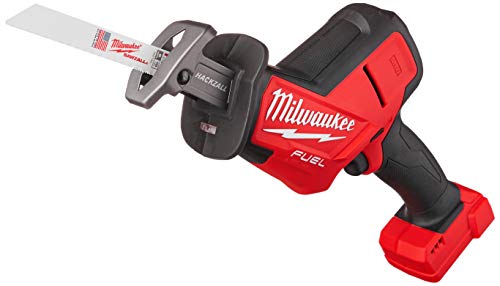
Milwaukee M18 FUEL One-Handed Hackzall
Best for: Precision cuts in tight spaces
- Power Source
- M18
- Stroke Length
- 7/8 in.
- Motor Type
- Brushless
- Battery Included
- Bare Tool
- Tool Weight
- 3.97 pounds
- Tool Length
- 14.8 inches
View on Amazon: Milwaukee M18 FUEL One-Handed Hackzall Affiliate link
The Milwaukee 2719-20 is a one-handed reciprocating saw designed for superior control. It features a 7/8-inch stroke length for faster material removal and a pivoting shoe to reduce vibration. Weighing 3.97 pounds, it offers a compact 14.8-inch length. This bare tool uses the M18 battery system and includes a brushless motor for increased power. It suits users needing precision in tight spaces.
Pros
- One-handed design for better control
- 7/8-inch stroke length removes more material
- Pivoting shoe reduces bucking and vibration
- Brushless motor increases cutting speed
Cons
- Sold as a bare tool without battery
- Heavier than standard one-handed reciprocating saws
- Shorter stroke length limits aggressive cutting speed
Good fit if
- You need precision in tight spaces
- You already own M18 batteries
- You value reduced vibration during cuts
Skip if
- You need a complete kit with battery
- You require maximum cutting speed for thick materials
- You prefer two-handed stability for heavy cuts
Verdict: Milwaukee M18 FUEL Hackzall One-Handed Reciprocating Saw fits users who prioritize control and reduced vibration over raw cutting speed. It is ideal for detailed work where a standard saw is too bulky.

Milwaukee M18 Fuel Brushless Reciprocating Saw
Best for: Demolition work with existing M18 batteries
- Power Source
- M18
- Motor Type
- Brushless
- Battery Included
- Bare tool only
- Tool Weight
- 6.8 pounds
- Tool Length
- 10 inches
- Blade Clamp
- Lever actuated
View on Amazon: Milwaukee M18 Fuel Brushless Reciprocating Saw Affiliate link
This Milwaukee M18 FUEL reciprocating saw is a bare tool designed for demolition and cutting tasks. It features a brushless motor for efficiency and a lever-actuated blade clamp for quick changes. The tool weighs 6.8 pounds and measures 10 inches in length. It includes a built-in LED light to illuminate your work surface. You need to supply your own M18 battery and charger.
Pros
- Brushless motor technology
- Lever actuated blade clamp
- Built-in LED work light
- Metal reinforced battery connection
Cons
- Sold as a bare tool without battery or charger
- Heavier at 6.8 pounds compared to compact alternatives
- No variable speed trigger mentioned in specifications
Good fit if
- You already own M18 batteries and chargers
- You need a durable tool with a metal reinforced battery connection
- You prefer fast blade changes with a lever actuated clamp
Skip if
- You need a complete kit with included battery and charger
- You require a lightweight tool under 5 pounds
- You are looking for a compact Hackzall style saw
Verdict: Milwaukee M18 FUEL Brushless Reciprocating Saw is a heavy-duty option for users who already have M18 power sources. It suits professionals who need a robust saw with a lever clamp and LED light for demolition work.
Specifications side by side
| Spec | Milwaukee M18 FUEL One-Handed Hackzall | Milwaukee M18 Fuel Brushless Reciprocating Saw |
|---|---|---|
| Power Source | M18 | M18 |
| Stroke Length | 7/8 in. | not stated |
| Motor Type | Brushless | Brushless |
| Battery Included | Bare Tool | Bare tool only |
| Tool Weight | 3.97 pounds | 6.8 pounds |
| Tool Length | 14.8 inches | 10 inches |
| Blade Clamp | not stated | Lever actuated |
| Included Tools | not stated | Reciprocating Saw |
| Dimensions | 14.8 × 4.4 × 6.8 inches | 10 × 6 × 4 inches |
| Weight | 3.97 pounds | 6.8 pounds |
| Size | Large | not stated |
| Color | Red, Black | Black |
| Model | 2719-20 | 2821-20 |
Frequently asked questions
Can I use the Milwaukee 2719-20 Hackzall for heavy demolition?
No, this tool is not designed for heavy demolition. It weighs only 3.97 pounds and measures 14.8 inches long. The verdict states it fits users who prioritize control and reduced vibration over raw cutting speed. It is ideal for detailed work where a standard saw is too bulky for tight spaces.
What is the weight difference between the Hackzall and the Sawzall?
The Hackzall weighs 3.97 pounds, while the Sawzall weighs 6.8 pounds. This is a difference of 2.83 pounds. The lighter Hackzall allows for easier one-handed operation. The heavier Sawzall provides more stability and power for demanding tasks like demolition work with existing M18 batteries.
Do these reciprocating saws come with batteries included?
No, neither tool includes a battery. The Milwaukee M18 FUEL One-Handed Hackzall is listed as a bare tool. The Milwaukee M18 Fuel Brushless Reciprocating Saw is also sold as a bare tool. You must purchase M18 batteries separately to operate either of these cordless power tools.
Which saw is better for precision cuts in tight spaces?
The Milwaukee M18 FUEL One-Handed Hackzall is the better choice for precision. It is specifically noted as being best for precision cuts in tight spaces. Its smaller dimensions and lighter weight allow for superior control. The standard Sawzall is bulkier and intended for more robust, general demolition tasks.
What are the physical dimensions of the Milwaukee 2719-20 Hackzall?
The Milwaukee 2719-20 Hackzall measures 14.8 inches in length, 6.8 inches in height, and 4.4 inches in width. It is classified as a large size tool. The color options are red and black. These compact dimensions support its design for one-handed use and maneuverability in confined areas.
Is the Milwaukee 2821-20 Sawzall suitable for professional demolition work?
Yes, it is suitable for professional demolition. The verdict describes it as a heavy-duty option for users who already have M18 power sources. It suits professionals who need a robust saw. Features like the lever clamp and LED light make it effective for demanding demolition environments.
How does the size of the Hackzall compare to the Sawzall?
The Hackzall is longer but narrower than the Sawzall. The Hackzall is 14.8 inches long and 4.4 inches wide. The Sawzall is 10 inches long and 6 inches wide. The Hackzall is also taller at 6.8 inches compared to the Sawzall's 4 inches. These differences affect how each tool fits in various workspaces.