Milwaukee vs Bosch Reciprocating Saws: Which Brand Fits You?
As an Amazon Associate we earn from qualifying purchases. Links on this page are affiliate links.
This comparison looks at the milwaukee vs bosch reciprocating saw options for your next job. Both tools run on 18-volt battery systems and come as bare tools. The main difference is form factor. Milwaukee offers a one-handed Hackzall design. Bosch provides a traditional D-handle saw. You need to decide which grip style matches your workflow.
Key differences
| Aspect | Milwaukee M18 FUEL One-Handed Hackzall | Bosch CRS180B 18V Compact Recip Saw |
|---|---|---|
| Motor Type | Brushless | not listed |
| Stroke Length | 7/8 in. | 1-1/8 in. |
| Tool Length | 14.8 inches | 17.7 inches |
| Weight | 3.97 pounds | 6.35 pounds |
| Blade Clamp | not listed | LockJaw |
Which one should you choose?
Choose Milwaukee M18 FUEL One-Handed Hackzall if
- You need a one-handed tool for tight spaces
- You want the lightest option at under 4 pounds
- You prefer a brushless motor for longer tool life
Choose Bosch CRS180B 18V Compact Recip Saw if
- You need a traditional D-handle for overhead work
- You want a longer stroke for faster material removal
- You value a quick blade-change system
Verdict: Choose the Milwaukee if you prioritize control and low weight for detailed cuts. Pick the Bosch if you need a standard grip and a longer stroke for aggressive demolition. Your choice depends on whether you work one-handed or two-handed.
Milwaukee vs Bosch Recip Saws
Form factor and control
The Milwaukee M18 FUEL Hackzall uses a one-handed design, which provides superior control and versatility compared to standard reciprocating saws. This compact layout measures 14.8 inches in length and weighs 3.97 pounds. The Bosch CRS180B features a traditional D-handle with an ergonomic shape and soft-grip zone. It is larger at 17.7 inches long and weighs 6.35 pounds. The one-handed Milwaukee option is lighter and more maneuverable for tight spots, while the Bosch D-handle offers a stable grip for two-handed power cuts. You should choose based on whether you prefer one-handed agility or two-handed stability.
Stroke length and speed
Stroke length determines how much material is removed per cut. The Milwaukee Hackzall has a 7/8-inch stroke length, which removes less material per stroke but allows for faster cuts in specific applications due to its brushless motor efficiency. The Bosch CRS180B features a longer 1-1/8-inch stroke, offering efficient material removal for tougher cuts. The Bosch also includes a variable-speed trigger, allowing you to ease the blade into the material. The Milwaukee relies on its POWERSTATE brushless motor for power. The Bosch wins here for raw cutting power and material removal efficiency.
Motor type and intelligence
The Milwaukee tool is powered by a POWERSTATE brushless motor, which increases cutting speed and power through tough applications. It also features REDLINK Plus Intelligence, an advanced electronic system that provides optimized performance and overload protection by communicating between the tool, battery, and charger. The Bosch data does not specify the motor type or mention an intelligent electronics system. The Milwaukee’s brushless motor and electronic protection system offer potential for longer tool life and better battery management compared to the unspecified Bosch motor.
Blade change system
The Bosch CRS180B features a LockJaw blade-change system, which provides fast and easy one-handed blade changes. This is a significant convenience factor for users who swap blades frequently. The Milwaukee Hackzall data does not explicitly describe its blade change mechanism in the provided specifications. While the Milwaukee is designed for one-handed use, the specific ease of blade replacement is not detailed. The Bosch clearly offers a dedicated, fast blade-change system, giving it a practical advantage for workflow efficiency.
Weight and overhead use
Weight is critical for overhead work. The Milwaukee Hackzall weighs only 3.97 pounds, making it significantly lighter than the Bosch. The Bosch CRS180B weighs 6.35 pounds, which the manufacturer notes is ideal for overhead work due to its balance, but it is still heavier than the Milwaukee. The Milwaukee’s lighter weight reduces fatigue during extended one-handed use. The Bosch’s extra weight may provide momentum for cutting but adds strain. For pure weight savings and reduced user fatigue, the Milwaukee is the better choice.
Which Reciprocating Saw Fits Your Needs
Users needing one-handed precision in tight spots
The Milwaukee M18 FUEL Hackzall measures 14.8 inches long and weighs 3.97 pounds. Its one-handed design offers superior control and versatility over standard reciprocating saws. The pivoting shoe maintains constant contact with the workpiece, resulting in smoother cuts with less bucking. This compact form factor is ideal for detailed work where a larger tool cannot fit.
Pros requiring aggressive material removal and overhead use
The Bosch CRS180B features a long 1-1/8 inch stroke for efficient material removal. Weighing 6.35 pounds, it is designed for overhead work. The LockJaw blade-change system allows fast, easy one-handed blade swaps. Two speed settings let you match cutting speed to material, while the variable-speed trigger helps you ease the blade into the work for better control during demolition tasks.
Cutters working in confined spaces with limited reach
At 14.8 inches in length, the Milwaukee Hackzall is significantly shorter than the Bosch option. This reduced tool length provides better maneuverability in tight spaces. The 7/8 inch stroke length removes more material per stroke than smaller recip saws, ensuring faster cuts despite the compact size. The brushless motor delivers increased cutting speed and power through tough applications.
The products compared
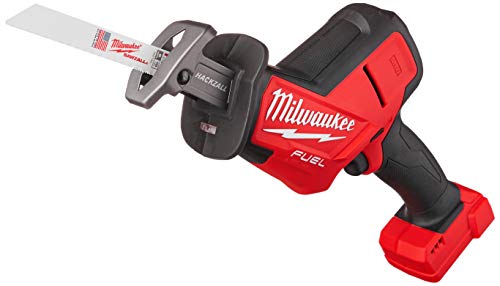
Milwaukee M18 FUEL One-Handed Hackzall
Best for: tight-space cutting with existing M18 batteries
- Power Source
- M18
- Stroke Length
- 7/8 in.
- Motor Type
- Brushless
- Battery Included
- Bare Tool
- Tool Weight
- 3.97 pounds
- Tool Length
- 14.8 inches
View on Amazon: Milwaukee M18 FUEL One-Handed Hackzall Affiliate link
The Milwaukee M18 FUEL Hackzall is a one-handed reciprocating saw designed for precision and control. It features a brushless motor and a 7/8-inch stroke length for faster material removal. Weighing 3.97 pounds and measuring 14.8 inches long, it fits tight spaces better than standard models. This bare tool runs on the M18 battery system, making it ideal for users already invested in the platform who need compact power.
Pros
- Brushless POWERSTATE motor delivers increased cutting speed and power
- 7/8-inch stroke length removes more material per stroke for faster cuts
- One-handed design offers superior control and versatility in tight spaces
- REDLINK Plus Intelligence provides optimized performance and overload protection
Cons
- Sold as a bare tool with no battery or charger included
- Heavier at 3.97 pounds compared to typical compact one-handed saws
- Shorter 14.8-inch length may limit reach in deep cuts
Good fit if
- You need a compact tool for detailed cutting in confined areas
- You already own M18 batteries and want to expand your kit
- You prioritize one-handed maneuverability over raw cutting power
Skip if
- You require a complete kit with battery and charger included
- You primarily perform heavy-duty demolition on thick lumber
- You prefer a traditional two-handed grip for stability
Verdict: The Milwaukee M18 FUEL Hackzall One-Handed Saw is a precise, compact option for users who already have M18 batteries and need a tool that fits into tight spaces. It suits those who value one-handed control and brushless efficiency over raw power and included accessories.

Bosch CRS180B 18V Compact Recip Saw
Best for: overhead work and tight spaces
- Power Source
- 18V
- Stroke Length
- 1-1/8 in.
- Battery Included
- Tool only
- Tool Weight
- 6.35 lbs.
- Tool Length
- 17.7 in.
- Blade Clamp
- Lockjaw
View on Amazon: Bosch CRS180B 18V Compact Recip Saw Affiliate link
This Bosch 18V reciprocating saw weighs 6.35 lbs and measures 17.7 inches long. You get a 1-1/8 inch stroke length and a LockJaw blade-change system. Two speed settings and a variable-speed trigger let you match cutting speed to material. The D-handle design features a soft-grip zone for comfort. This compact tool suits overhead work and tight spaces where maneuverability matters most.
Pros
- Weighs only 6.35 lbs for overhead work
- Compact 17.7-inch tool length for tight spaces
- LockJaw system allows fast one-handed blade changes
- Two speed settings and variable-speed trigger
Cons
- Sold as a bare tool without a battery
- Single speed setting per mode requires manual adjustment
- Limited to 1-1/8 inch blade capacity
Good fit if
- You need a lightweight saw for overhead tasks
- You work in tight spaces with limited clearance
- You prefer a D-handle ergonomic grip
Skip if
- You require a battery and charger included
- You need a longer stroke for heavy demolition
- You prefer a pistol-grip handle design
Verdict: Bosch 18V Compact Reciprocating Saw is ideal for users who prioritize weight and compactness. You should choose this model if you frequently work in confined areas or overhead positions.
Specifications side by side
| Spec | Milwaukee M18 FUEL One-Handed Hackzall | Bosch CRS180B 18V Compact Recip Saw |
|---|---|---|
| Power Source | M18 | 18V |
| Stroke Length | 7/8 in. | 1-1/8 in. |
| Motor Type | Brushless | not stated |
| Battery Included | Bare Tool | Tool only |
| Tool Weight | 3.97 pounds | 6.35 lbs. |
| Tool Length | 14.8 inches | 17.7 in. |
| Blade Clamp | not stated | Lockjaw |
| Variable Speed Trigger | not stated | Variable-speed trigger |
| Voltage | not stated | 18V |
| Included Tools | not stated | Reciprocating Saw |
| Dimensions | 14.8 × 4.4 × 6.8 inches | 17.7 × 4 × 6.8 inches |
| Weight | 3.97 pounds | 6.35 pounds |
| Size | Large | not stated |
| Color | Red, Black | Black |
| Model | 2719-20 | CRS180B |
Frequently asked questions
Which reciprocating saw is lighter for overhead work?
The Milwaukee M18 FUEL Hackzall is the lighter option. It weighs 3.97 pounds, making it easier to hold above your head for extended periods. The Bosch CRS180B weighs 6.35 pounds. The extra weight may cause fatigue during overhead tasks. Choose the Milwaukee if reducing hand strain is your priority.
Which saw is more compact for tight spaces?
The Milwaukee M18 FUEL Hackzall is more compact. It measures 14.8 inches in length and 4.4 inches in width. The Bosch CRS180B is longer at 17.7 inches and slightly narrower at 4 inches wide. The Milwaukee’s shorter body allows it to fit into tighter gaps and confined areas more easily.
Do I need to buy batteries for these tools?
Yes, you must purchase batteries separately for both models. The Milwaukee M18 FUEL Hackzall is sold as a bare tool. The Bosch CRS180B is also listed as a bare tool. You will need compatible 18-volt batteries to operate either saw. Check your existing battery inventory before buying.
Which brand offers a one-handed cutting design?
Milwaukee offers a one-handed cutting design with the M18 FUEL Hackzall. This layout allows you to operate the saw with a single hand. The Bosch CRS180B uses a traditional D-handle design. You will need two hands to control the Bosch saw. The Milwaukee option provides better versatility for one-handed use.
Which reciprocating saw is better for precision cutting?
The Milwaukee M18 FUEL Hackzall is better for precision cutting. Its compact size and one-handed control offer superior maneuverability. The Bosch CRS180B is designed for general compact use. The Milwaukee’s smaller footprint allows for more accurate cuts in restricted spaces. It suits users who value control over raw power.
What is the maximum chuck size for the Bosch saw?
The Bosch CRS180B features a 1-1/8 inch chuck size. This standard size accepts most common reciprocating saw blades. The Milwaukee Hackzall data does not specify a chuck size. Both tools run on 18-volt systems. The Bosch chuck size ensures compatibility with a wide range of standard blades.